

When a Trusted Contributor Gets Compromised
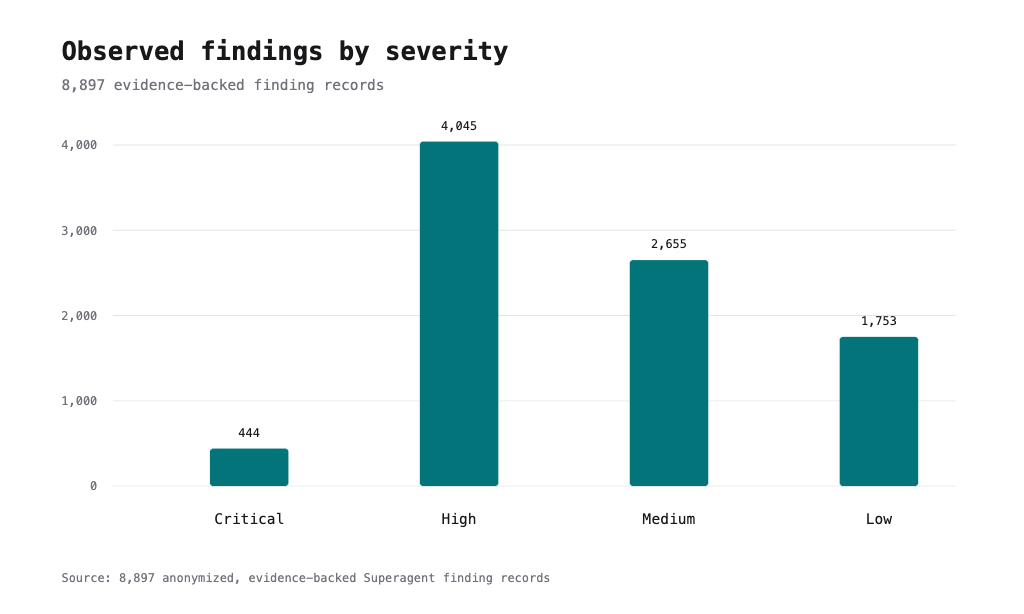
We analyzed 8,897 evidence-backed GitHub posture findings to measure how repository controls limit a compromised contributor.
Suppose a trusted contributor gets pwned. GitHub sees a familiar account with legitimate write access. The repository still has to decide how far that account can go.
A resilient repository forces every change through independent gates before it reaches users.
We analyzed posture scans from 2,554 connected repositories. Scans completed for 1,611 of them and produced 8,897 evidence-backed findings. Of those completed scans, 98.0% had at least one observed finding; 81.8% had an observed high- or critical-severity finding.
Several recurring gaps created direct paths toward production.
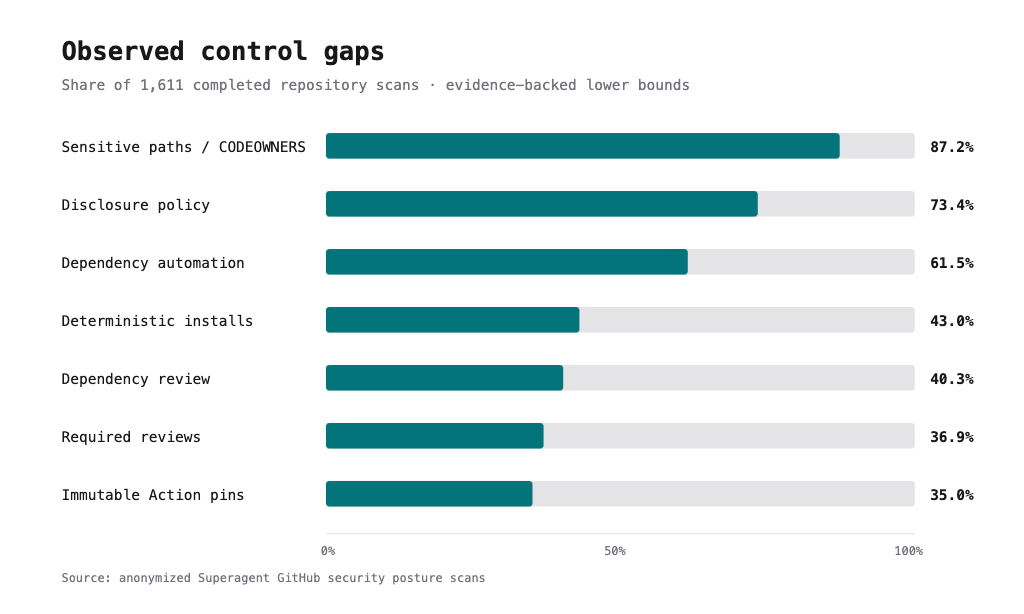
Observed findings provide a lower bound: inadequate sensitive-path ownership or CODEOWNERS appeared in 87.2% of completed scans, missing disclosure policies in 73.4%, weak dependency automation in 61.5%, missing dependency-review gates in 40.3%, and mutable GitHub Action references in 35.0%.
These gaps also compound. CI/CD hardening and sensitive-path ownership findings co-occurred in 62.8% of completed scans.
Imagine the repository as a pipeline:
contributor → review → workflow → release → user
Each stage can interrupt a compromised account. CODEOWNERS brings another person into sensitive changes. Dependency review exposes graph changes. Full-SHA Action pins lock upstream code. Read-only workflow tokens constrain execution. Protected environments, OIDC publishing, and provenance add authorization and traceability to releases.
Five gates to add this week
- Protect default and release branches with required reviews. Add CODEOWNERS for workflows, manifests, lockfiles, and release configuration.
- Pin every third-party Action to a full commit SHA. Set the default
GITHUB_TOKENpermission to read-only and grant write access per job. - Require dependency review and lockfile validation whenever the dependency graph changes.
- Put publishing behind a protected environment with approval. Replace long-lived release secrets with short-lived OIDC credentials.
- Generate provenance for released artifacts and alert when repository protections change.
Test the path with a staging account that has contributor access. Attempt to change a workflow, weaken a gate, and publish. Record every successful shortcut. A healthy result requires an independent approval between that account and the final artifact.
Coverage remains a limitation: 36.9% of connected repositories had only failed scans. These results describe the repositories the scanner successfully assessed.
Treat contributor compromise as a normal operating condition. Build enough gates that one valid identity never becomes a release credential.